Legal classes can be overwhelming. There are always hundreds of cases to analyze, and brief about. You are required to interpret statutes as well as understand different legal principles and theories. Most often, you are required to read through volumes of law reports to understand these principles that will form your style of argument when you get to practice of the law.
While many approach legal principles like they would approach a random piece of literature, the study and understanding of the law requires a ground approach that ensures you retain most of the information you come across. It will not be easy going back and forth through different legal principles. You need a full proof way to make sure you keep abreast with all the lessons you learn to be the outstanding student that you desire to be. This approach is called the IRAC method, and it applies to different topics and laws related to the law.
When used properly, the IRAC method is one of the deepest and most versatile analytical tools you will ever use in your legal education journey. The method transforms how you answer questions in your assignments, projects, dissertations, and exams. It also helps you structure and approach your case reading, research, problem-solving, and even prepare for your moot court advocacy sessions.
What is the IRAC Method?
Simply put, the IRAC method is an abbreviation for ‘Issue, Rule, Application, and Conclusion. In essence, using the IRAC method requires you to identify the issue under investigation, identify the applicable rule that s used to prosecute the conflict issue, explain how the rule is applied with evidence, before making a conclusion on the way forward or jurisprudence of the issue. Using this judicial reasoning approach, the IRAC method ensures that you become the top student preparing for the best days of your practice. It makes you the professional you want to become.
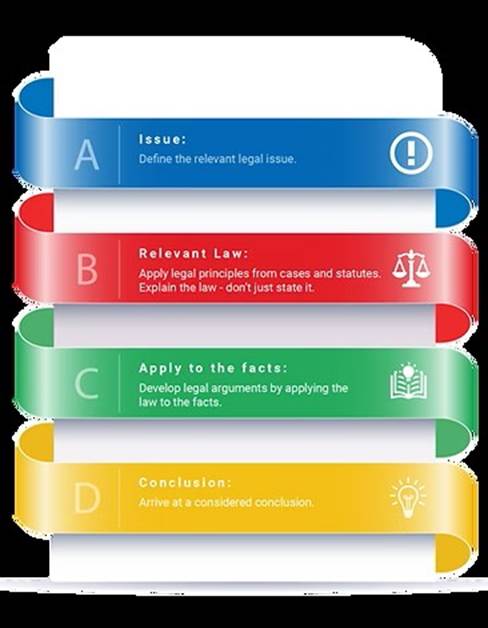
Why IRAC is the preferred model for legal education
The IRAC method is taught at different levels because it mirrors grounded legal or judicial thinking. The method has been applied in many leading precedents such the famous cases of Donoghue v Stevenson, and Caparo v Dickman. In the cases, you can rightly pinpoint the issue, articulation of the legal test, application of the test to provided facts, and a definite conclusion following the method. It does not matter that these steps take paragraphs or pages – the structure remains the same.
As such, the method is taught in almost all law schools the world over and continues to inform how solicitors approach their legal thinking. It emphasizes adhering to a system that values discipline in the analysis and structuring of thought, and tying legal arguments to the law and evidence covering a specific are of practice.
Let’s Break it Down
The first step in case analysis is to identify the issue in the case. More often than not, this is the conflict that warring parties are feuding about.
Identifying the issue must be proper. Identifying an issue is not about scanning the problem question and restating it in different words. Nor is it about writing vague statements like “The issue is whether the defendant is liable for negligence.”
A strong legal issue isolates the tension in the facts. It identifies the exact legal uncertainty in dispute. It frames the conflict in a way that directs the rest of your argument.
For example, say a café serves a takeaway coffee with a loose lid, causing the customer burns. The issue is not “negligence”. That is too broad. A high-scoring student would frame it like this:
“The issue is whether the café, as a commercial occupier, owed a duty of care to the customer when serving a hot beverage, and whether providing a loose lid constitutes a breach resulting in foreseeable harm.”
That single sentence signals sophistication. It subtly introduces the structure of negligence (duty, breach, causation, damage) without prematurely applying it. It shows that you understand the legal test before you even articulate it.
Look at Donoghue v Stevenson — the court did not simply ask whether negligence occurred. It asked:
“Does a manufacturer owe a duty of care to an ultimate consumer with whom it has no contractual relationship?”
The precision of the issue shapes the entire case. When you learn to frame issues that precisely, your answers immediately begin to resemble the reasoning of appellate courts.
The Rule: Stating the Law with Authority and Purpose
The “Rule” section is where students often underperform because they treat it as a space to dump every case they know. Memorisation is not the point. The rule section should distil the legal principle governing the issue you identified — and no more.
Rules must be authoritative, current, and directly relevant. This is where your understanding of leading cases and statutory provisions becomes invaluable. The challenge is not remembering them; it is selecting and articulating them concisely.
Suppose the issue concerns whether an advertisement constitutes an offer. A student aiming for average will state:
“An offer is an expression of willingness to contract.”
While correct, it is insufficient.
A top student will add legal context:
“An offer is a definite promise to be bound upon acceptance. As illustrated in Carlill v Carbolic Smoke Ball Co (1893), advertisements containing clear promises and evidence of real intention — such as deposits or reward guarantees — may constitute unilateral offers rather than invitations to treat.”
See how much more substance appears in a similar word count?
In criminal law, vagueness is even more dangerous. Consider recklessness. A student who merely cites R v Cunningham fails to show an understanding of the law’s development.
A stronger rule section acknowledges the evolution of recklessness:
“Recklessness adopts a subjective standard requiring foresight of risk, reaffirmed in R v G (2003). The defendant must have consciously recognised the risk yet proceeded unreasonably.”
Clarity and precision demonstrate maturity. You’re not just reciting rules — you are showing that you understand their purpose, evolution, and practical implications.

The Application: Where Real Legal Thinking Happens
The application section is where the quality of your legal thinking becomes visible. It is also the part that most distinguishes a First-Class answer from a Third.
Application is not describing the law again. And it is not summarising the facts. Application is a negotiation between the rules and the facts — an intellectual wrestling match that shows the examiner your reasoning process.
Weak application looks like this:
“The café was negligent because burns are foreseeable.”
This is an assertion, not an analysis.
Effective application unfolds slowly and thoughtfully:
“Burns caused by loose lids on hot beverages are plainly foreseeable, reflecting the general foreseeability principle established in Donoghue, where the harm from contaminated products was considered predictable. Here, the café’s act of handing over a hot drink with a poorly secured lid mirrors the type of avoidable hazard that the courts consistently view as falling within a commercial occupier’s responsibility. A reasonable café operator would anticipate that a loose lid could detach during handling.”
This kind of reasoning demonstrates weight, logic, and engagement with the facts. You are no longer giving conclusions — you are justifying them.
Application is where your argument breathes.
The Conclusion: Clarity Without Overconfidence
Students often feel compelled to sound definitive in their conclusions, but the best legal conclusions recognise the inherent uncertainty of the law.
A strong conclusion bridges the reasoning without overstating certainty:
“On balance, the café is likely to be found in breach of duty, given the foreseeability of harm, the clear commercial relationship, and the simple precautionary steps that could have prevented the risk.”
Legal conclusions should be decisive, but not absolute. Examiners appreciate nuance.

IRAC as a Tool for Case Briefing
UK law students often struggle to brief cases effectively. Many write pages of excessive detail without capturing the essence of the case. IRAC offers a simple but effective structure for breaking down judgments.
Take Caparo v Dickman (1990), a cornerstone of negligence law.
Issue:
Whether auditors owe a duty of care to investors relying on audited accounts.
Rule:
The court articulated the three-part test: foreseeability, proximity, and fairness.
Application:
The auditors’ statutory role did not create sufficient proximity to shareholders making investment decisions.
Conclusion:
No duty owed.
This structure mirrors judicial reasoning, making IRAC an exceptional case-briefing tool. When students master this skill, they read cases faster, retain information better, and improve significantly in essays.
IRAC in Moot Court: The Secret Weapon for Persuasive Advocacy
The best moot court teams in the UK quietly deploy IRAC throughout their submissions. They may not mention the acronym explicitly, but their structure mimics it flawlessly.
When an advocate opens with:
“Your Honours, this appeal raises two central issues…”
They are identifying the Issue.
When they proceed to cite precedents, statutes, and legal principles, they are delivering the Rule.
When they distinguish the present facts from those in Miller, Carlill, or Ghosh, they are engaging in Application.
And when they end with:
“For these reasons, we respectfully request that the court allow the appeal.”
They are concluding.
The brilliance of IRAC in moot court is that it helps advocates stay grounded when judges interrupt or redirect the argument. It ensures that even under pressure, your structure does not collapse.
IRAC Applied to the Most Examined Legal Doctrines in the UK
Below are expanded, prose-style walkthroughs of doctrines every law student encounters.
1. Duty of Care and the Caparo Test
Negligence is a foundational tort, and the duty of care element often consumes disproportionate attention in exams. The Caparo three-part test remains the gold standard for establishing duty. What students misunderstand is that each limb of the test requires careful application.
Foreseeability is usually straightforward, but proximity and fairness demand nuance. Courts often analyse proximity by examining whether the relationship between the parties resembles previous recognised duty scenarios — occupier/visitor, driver/pedestrian, manufacturer/consumer. Fairness, meanwhile, reflects judicial hesitation to impose duties on public authorities or impose excessive obligations on individuals.
By articulating each limb carefully, you demonstrate to the examiner not only that you understand the structure but that you recognise the policy considerations embedded within tort law.
2. Offer, Acceptance, and Intention in Contract Law
Contract formation questions are notoriously tricky because they require distinguishing subtle differences between invitations to treat, offers, counteroffers, and conditional acceptances. Using IRAC here helps untangle the confusion.
A refined explanation of Carlill v Carbolic Smoke Ball Co reveals how intention, rather than mere advertisement, is the key. Students who grasp this nuance can apply it to modern equivalent scenarios — promotions, online adverts, and reward campaigns. The real skill lies in connecting 19th century reasoning to contemporary contexts.
3. Mens Rea and the Evolution of Recklessness
Criminal law requires students to handle fluid concepts, none more famously contested than recklessness. The evolution from Cunningham to G demonstrates the law’s attempt to balance moral blameworthiness against practical enforcement.
When you apply IRAC in criminal scenarios, the application becomes the heart of the analysis. For example, in arson or assault cases, distinguishing whether the defendant foresaw the risk — and whether that foresight was subjective — is where deeper marks lie.
4. Judicial Review and Constitutional Principles
Judicial review questions often intimidate students because of their perceived complexity. But IRAC simplifies them.
Start with the issue: was the decision unlawful?
Then articulate the rules: illegality, irrationality, procedural impropriety.
Then apply: how exactly did the public authority exceed their power or fail to follow procedural fairness?
Finally conclude: is the decision likely to be quashed?
IRAC lends clarity to a topic filled with conceptual tension.

5. Proportionality in Human Rights Law
Human rights assessments demand elegance in reasoning. The proportionality test—particularly after Bank Mellat—provides a sensitive and flexible framework. Applying proportionality requires more than stating the four limbs; it demands demonstrating how the measure fails (or passes) each limb in turn.
A mature IRAC answer here recognises that rights adjudication is a balancing exercise, not a mathematical calculation.
Why IRAC Works Better Than Any Other Method
There are alternative structures — ILAC, MIRAT, CREAC — but IRAC holds a unique advantage: its conceptual simplicity hides profound analytical power. It mirrors judicial reasoning. It helps students transition from descriptive writing to evaluative reasoning. And above all, it makes your work easier to read — something examiners appreciate more than most students realise.
Final Thoughts: The Student Who Masters IRAC Masters Legal Thinking
IRAC is not merely a writing technique. It is a mindset. It is a way of approaching every legal problem with discipline, clarity, and a respect for legal reasoning.
When you think in IRAC, you read cases more effectively.
When you write in IRAC, your arguments become sharper.
When you speak in IRAC, your advocacy becomes more persuasive.
If you want to become the sort of law student who consistently produces structured, compelling, and judicial-quality reasoning, IRAC is your gateway.
Need Help With IRAC, Problem Questions, or Law Assignments?
For many students — especially those balancing part-time work, family responsibilities, or multiple modules — even the clearest structure can be challenging under tight deadlines. That’s where TopUrgentEssays.com comes in.
Our academic writers specialise in:
- UK law assignments and essays
- IRAC-structured problem questions
- Case analyses and briefs
- Moot court research
- LLB, GDL, LPC, LLM writing
- Tight deadlines (24–72 hours)
- Real legal accuracy and academic quality
If you want your legal writing to be clear, confident, and professionally structured, visit www.topurgentessays.com today and get expert help trusted by students across the UK, EU, and US.